



What Is a Mamluk Rug? History, Patterns & Why Collectors Love Them
What Is a Mamluk Rug?
The 500-Year-Old Mystery Behind Cairo's Most Kaleidoscopic Carpets
By Merchants of Asia · Rug History & Culture · 2,100 words · 9 min read
Imagine a Cairo workshop in 1485. A master weaver sits cross-legged before a vertical loom, threading dyed wool through warp strings in a sequence he learned from his father, who learned it from his. There is no cartoon — no paper pattern nailed to the beam. The design lives in his hands. What emerges, knot by patient knot, is something the Western world has never seen: a carpet that folds geometry back on itself like a mirror held to a mirror, radiating from a central star in every direction at once.
The rug he is making will travel by merchant ship to Venice. It will be placed on a table — not a floor — in a palazzo, handled with the reverence reserved for precious objects. A generation later, it will appear in the background of a Renaissance painting. And five hundred years after that, scholars will still be arguing about exactly who made it, where, and how.
That is the world of the Mamluk rug — one of the most extraordinary and least-understood traditions in carpet history. If you have encountered one and felt immediately that it was different from any rug you had seen before, you were right. This guide explains what Mamluk rugs are, why they matter, and what makes them genuinely unlike anything else woven in the ancient world.
Who Were the Mamluks — and Why Does It Matter?
Before you can understand the rug, you need to understand the culture that produced it. The Mamluk Sultanate (roughly 1250 to 1517 AD) was one of history's most unusual dynasties. The word 'Mamluk' translates loosely as 'owned' or 'enslaved' — because the founders of this empire were originally military slaves, soldiers purchased as boys from Turkic and Caucasian territories and trained to form an elite warrior class for the Ayyubid Sultans who preceded them.
They seized power in Egypt in 1250, and for nearly three centuries they ruled one of the wealthiest and most culturally sophisticated states in the Islamic world. Cairo became a centre of gravity for artists, craftsmen, scholars, and traders. The Mamluks were prolific builders — their mosques, mausoleums, and madrasas still define the skyline of medieval Cairo — and equally ambitious patrons of the decorative arts: metalwork, glassware, carved stone, inlaid woodwork, and textiles.
The Mamluks were originally soldier-slaves who became kings — and then became some of the most ambitious patrons of art and craft the medieval world had ever seen.
It was in this environment of concentrated wealth and aesthetic ambition that a new carpet tradition was born. The earliest documented Mamluk rugs date to the late 15th century — a moment when Cairo's workshops were already producing luxury goods for export across the Mediterranean. No surviving document tells us who commissioned the first Mamluk rug, or which workshop wove it. That is the mystery that makes these textiles so compelling.
What Does a Mamluk Rug Actually Look Like?
The visual identity of a Mamluk rug is so distinctive that once you have learned to see it, you will never confuse it with anything else. Three things define the look: the colour palette, the geometric system, and the almost hallucinatory density of the patterning.
The colour palette: disciplined and deliberate
Mamluk rugs use a restricted set of colours. The dominant tones are a deep crimson red (derived from madder root), a rich indigo blue, and a saturated emerald green. Ivory, yellow, and black appear as accents. This sounds limiting — and in the hands of lesser craftsmen it would be — but the Mamluk weavers used these colours the way a great composer uses a small ensemble: through contrast, proportion, and the relationship between adjacent tones rather than sheer variety.
The natural dyes used in antique Mamluk examples often show what dyers call abrash — subtle variations in tone across a single colour field as dye lots differ slightly. In lesser rugs this reads as inconsistency. In a Mamluk rug it reads as depth, a kind of shimmering quality that no machine-made rug can replicate.
The geometry: a kaleidoscope in wool
The central motif in a Mamluk rug is almost always a medallion — typically an eight-pointed star, an octagon, or a many-sided polygon — positioned precisely at the visual centre of the field. From this medallion, the geometry radiates outward in a self-similar system: each layer of pattern echoes the layer before it, scaling and rotating as it expands toward the border.
The effect is genuinely kaleidoscopic — not as a metaphor, but as a structural description. If you were to rotate a Mamluk medallion by 45 degrees, the surrounding geometry would rotate with it without breaking. The whole composition is built on a logic of rotational symmetry that scholars have spent decades trying to reverse-engineer.
Design note: Unlike Persian city rugs, which typically feature a central medallion surrounded by a curvilinear floral field, Mamluk rugs fill every inch of the ground with geometric patterning. There is no open field, no breathing space. The density is total and completely intentional.
The borders reinforce the composition rather than interrupting it. A typical Mamluk rug has three or more border bands, each carrying its own geometric pattern that is distinct from — but harmonically related to — the central field. The outermost guard borders are usually narrow and restrained, allowing the eye to settle before the central drama begins.
What a Mamluk rug is not
This matters for authentication. Mamluk rugs contain no floral scrollwork — that vocabulary belongs to Persian city rugs. They contain no figural imagery — human or animal — as Islamic art conventions and the Mamluk aesthetic both discouraged representation. They contain no narrative scenes, no landscape references, no calligraphic inscriptions in the field. The design language is pure geometric abstraction, and any rug claiming to be Mamluk but featuring curvilinear flowers or figures is either mislabelled or belongs to the later Ottoman-Cairo hybrid tradition.
How Mamluk Rugs Are Made: The Technical Secrets
To understand why Mamluk rugs are valued the way they are, you need to understand how they are constructed. The differences between a Mamluk rug and a typical Persian rug are not just aesthetic — they extend to the very way the wool is processed.
S-spun wool: the fingerprint of Cairo
The most technically distinctive feature of a Mamluk rug is the spin direction of its wool. Most rug-weaving traditions — Persian, Turkish, Caucasian — use Z-spun wool, in which the fibres are twisted in a counter-clockwise direction. Mamluk rugs use S-spun wool, twisted clockwise. This is not a small detail. S-spun wool was standard in Egyptian textile production, and its presence in a rug is one of the key technical signatures that a curator or appraiser uses to confirm a Cairo origin.
Knot structure and density
Mamluk rugs use the asymmetric knot (sometimes called the Persian knot), tied to a single warp thread. This allows for the high-resolution geometric detail that the Mamluk designs require. Original antique examples — particularly the court-quality pieces now in museum collections — can achieve knot densities exceeding 300 knots per square inch. At that density, the pile surface approaches the resolution of a woven textile rather than a knotted pile rug.
The warps are depressed in Mamluk construction — meaning alternate warp threads are pulled behind the others — which produces a structure that is both dense and flexible. This is one reason well-preserved examples from the 15th and 16th centuries have survived in such remarkable condition: the construction is inherently stable.
Scale: these were not small rugs
The earliest Mamluk rugs were made for grand spaces — mosque prayer halls, palace reception rooms, diplomatic gifts. Many were extremely large by the standards of their era. The scale of the geometric composition is partly what makes it so effective: the radiating medallion system is designed to be viewed from a distance, from a standing position, and it rewards that perspective with a visual coherence that smaller, more intimate rugs cannot achieve.
The Venetian Connection: How Mamluk Rugs Entered the Western World
The story of how Mamluk rugs reached Europe is inseparable from the story of Venice. In the 15th and 16th centuries, the Venetian Republic was the primary trading gateway between the Islamic world and Christian Europe. Venetian merchants maintained permanent trading colonies — called fondaci — in Cairo and Alexandria, and they imported goods that the European market had never encountered: spices, silks, glassware, and luxury carpets.
When the first Mamluk rugs arrived in Venice, they were immediately recognised as something exceptional. They were not placed on floors — which would have been their fate in Egyptian palaces — but displayed on tables and altar steps, draped over balconies on feast days, handled with the ceremony reserved for precious objects. The Venetians understood, even without a vocabulary for it, that these were works of art.
Venetian merchants who traded in Cairo brought Mamluk rugs back to Europe — where they were placed on tables, not floors, and treated with the reverence of precious objects.
The most remarkable evidence of this is in the paintings. Renaissance artists — Hans Holbein the Younger, Lorenzo Lotto, Jan van Eyck, Giovanni Bellini — included oriental carpets in their works as markers of wealth, taste, and international connection. Art historians have spent considerable energy identifying the rug types depicted in these paintings, and several — particularly the bold geometric carpets in Holbein's work — are now believed to represent the Mamluk tradition or its immediate descendants.
This is the origin of the term 'Holbein carpet': not a rug Holbein made, but a type of geometric oriental rug that appears so frequently in his paintings that art historians named the category after the painter who recorded it. The Mamluk rug, in other words, was so significant in 16th-century European culture that it left a permanent mark on the history of Western art.
After the Ottoman Conquest: Did Mamluk Weaving Survive?
In 1517, Ottoman forces under Sultan Selim I defeated the last Mamluk Sultan and absorbed Egypt into the Ottoman Empire. It is one of the pivotal moments in Middle Eastern history — and it raises an immediate question for rug historians: what happened to the Cairo workshops?
The answer, as best as scholarship can determine, is that production continued — but it changed. The skilled weavers and dyers of Cairo did not disappear with the Mamluk Sultanate. The workshops survived, the craft knowledge was intact, and there was still a market for luxury Egyptian carpets. But Ottoman taste was different from Mamluk taste. The Ottoman court in Istanbul favoured more naturalistic designs — curvilinear florals, the influence of Iznik tilework, compositions derived from the imperial ateliers of Persia.
Gradually, Cairo weavers began to incorporate these Ottoman elements into their work. By the mid-16th century a new hybrid style had emerged — sometimes called Ottoman-Cairo carpets — that blended the Mamluk geometric base with the Ottoman love of floral motifs and more varied colour palettes. These rugs are fascinating objects in their own right, but they are distinct from the pure Mamluk tradition that preceded the conquest.
For collectors: This transition matters for authentication. A rug with a Mamluk-style geometric medallion but incorporating curvilinear floral elements in the field likely dates from after 1517 and belongs to the Ottoman-Cairo tradition rather than the Mamluk period. Both are historically significant — but they command different prices and carry different stories.
How to Find and Buy a Mamluk-Style Rug Today
True antique Mamluk rugs — pieces woven in 15th or early 16th century Cairo — are almost entirely in museum collections. The Kunsthistorisches Museum in Vienna, the Museum of Islamic Art in Cairo, and the Metropolitan Museum of Art in New York hold some of the finest surviving examples. Private sales of authenticated pieces of this age are extremely rare and command prices that put them firmly in the category of fine art rather than decorative object.
For collectors and interior designers, the more practical question is the contemporary revival tradition: hand-knotted rugs woven today using the Mamluk geometric vocabulary, natural dye palettes, and traditional construction methods. These rugs carry the same visual DNA as their 15th-century ancestors — the radiating medallion, the restricted palette, the dense geometric field — produced by skilled weavers in Egypt, India, and Pakistan working from pattern books derived from historical examples.
What to look for when buying
The most important thing to verify is construction. A genuine hand-knotted Mamluk-design rug will show irregular knot patterns on the reverse side — no two rows are perfectly identical. The pile will have a slight variation in colour across the field (abrash) from natural dye lots. The fringe will emerge directly from the warp threads, not be sewn on separately. Machine-made imitations can approximate the geometric pattern but cannot replicate any of these structural qualities.
For the design itself: look for a clear central medallion — star, octagon, or multi-pointed polygon — from which the geometry radiates without interruption to the borders. The colour palette should be dominated by deep reds, blues, and greens. If the rug has pastel tones, a cream or beige ground field, or curvilinear floral elements, it is not in the Mamluk tradition.
Price ranges for contemporary Mamluk-design rugs
Entry-level hand-knotted Mamluk-design pieces in smaller sizes (3×5 to 5×7 feet) typically start from $800 to $2,500. Mid-range room-size rugs (8×10 to 9×12 feet) in high-quality wool or wool-silk blends range from $2,500 to $8,000. Fine examples in pure silk or with exceptionally high knot density can exceed this significantly. Pricing reflects knot density, material quality, the refinement of the dye work, and the precision of the geometric execution.
Browse our curated Mamluk rug collection — each piece in our inventory is individually assessed for construction quality and design authenticity. If you already own a piece you believe may be a genuine antique, our professional rug appraisal service can provide a certified valuation for insurance, estate, or sale purposes.
Looking for a Mamluk rug? We carry hand-knotted Mamluk-design pieces in a range of sizes and price points. Browse the collection →
Styling a Mamluk Rug in a Contemporary Home
There is a persistent misconception that geometric oriental rugs — and Mamluk designs in particular — belong only in traditional interiors: dark wood panelling, heavy upholstery, a library full of leather-bound books. This could not be further from the truth.
The bold, abstract geometry of a Mamluk rug is deeply compatible with contemporary interiors precisely because it is not decorative in the Victorian sense. It does not tell a story or depict a scene. It is pure pattern — the same quality that makes Mondrian hang successfully in a modern apartment, or a Navajo weaving look extraordinary against a white wall. A Mamluk rug in a room with minimal, solid-colour furniture and clean architectural lines will often look more at home than it would surrounded by competing patterns.
The key principle is simplicity around the rug. Mamluk geometry is complex enough to carry a room on its own. Keep upholstery in solid tones — pulling one of the rug's colours into a cushion or throw is more than enough. Dark wood furniture — walnut, oak, ebony — responds well to the deep saturated palette of a Mamluk piece. Stone floors, concrete, and dark hardwood all provide a neutral ground that lets the rug read as the focal point it is designed to be.
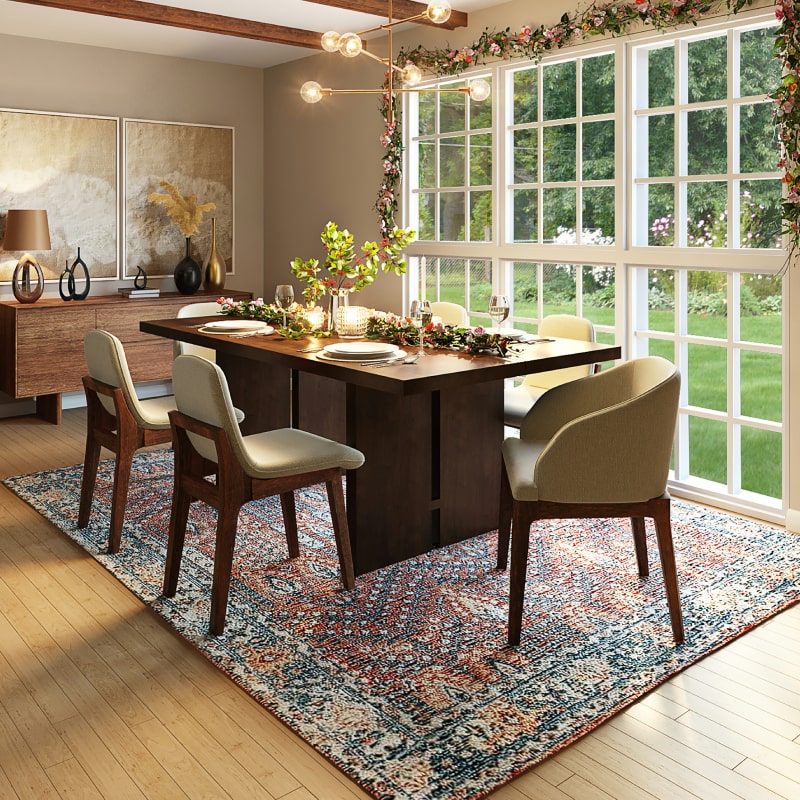
For room sizing, the same rules apply as any area rug: in a living room, at least the front legs of the sofa and armchairs should sit on the rug. In a dining room, the rug should extend far enough beyond the table that chairs remain on it when pulled out. See our complete rug sizing guide for room-by-room recommendations.
Frequently Asked Questions
What makes a Mamluk rug different from a Persian rug?
The fundamental difference is the design language. Persian city rugs — Tabriz, Isfahan, Kashan — typically feature curvilinear floral fields, a central medallion surrounded by botanical scrollwork, and a palette that can include pastels, pinks, and ivory grounds. Mamluk rugs are purely geometric. No flowers, no scrollwork, no figural imagery. The colour palette is restricted to deep reds, blues, and greens. The geometry radiates from the centre in a self-referential system unlike anything in the Persian tradition. The construction also differs: Mamluk rugs use S-spun wool, which is the technical fingerprint of the Egyptian weaving tradition.
Are Mamluk rugs rare?
Original 15th and 16th century Mamluk rugs are among the rarest textiles in existence — the vast majority are in museum collections and essentially never come to market. Contemporary hand-knotted Mamluk-design rugs, woven by skilled craftsmen using the same geometric vocabulary and traditional dye methods, are available through specialist dealers including our own Mamluk collection. They represent the most accessible way for collectors and designers to engage with this tradition.
How do I know if a Mamluk rug is authentic?
For a contemporary hand-knotted Mamluk-design rug: check the reverse side for irregular knotwork (all hand-knotted rugs show this), confirm the fringe emerges from the warp (not sewn on), and verify the design is purely geometric with a radiating medallion composition. For a piece claimed to be a genuine antique, only a certified appraiser with expertise in Islamic textiles can confirm authenticity — our rug appraisal service provides professional evaluation for exactly this purpose.
What room suits a Mamluk rug best?
Mamluk rugs are statement pieces that work best as the clear focal point of a room. Living rooms with solid-colour upholstery, dining rooms, libraries, and studies are all natural settings. The strong geometric palette — deep reds, blues, and greens — pairs exceptionally well with dark wood furniture, stone, leather, and concrete. Avoid busy wallpapers, heavily patterned upholstery, or rooms with competing focal points. The rug needs space to read.
Why do Mamluk rugs appear in Renaissance paintings?
Because Venice was the primary trading hub between Egypt and Europe in the 15th and 16th centuries, and Mamluk rugs were among the luxury goods that Venetian merchants imported from Cairo. In Renaissance Europe, an oriental rug was a potent symbol of wealth, taste, and international connection — which is precisely why painters like Hans Holbein the Younger and Lorenzo Lotto included them in portraits of wealthy patrons. The term 'Holbein carpet' used by art historians today refers to the geometric carpet type — Mamluk-derived — that appears so frequently in Holbein's work.
Five Hundred Years Later
The mystery at the heart of the Mamluk rug tradition is also its greatest gift. We do not know the name of the weaver who tied the first knot of the first great Mamluk carpet. We do not know which Sultan or merchant commissioned it, or which Cairo workshop produced it. We have no design documents, no correspondence, no guild records. What we have are the rugs themselves — and they are enough.
They tell us, in the language of geometry and colour, that a civilisation at its height of power and aesthetic sophistication decided to encode something profound into wool and dye: a pattern that folds back on itself, that generates complexity from simplicity, that rewards close looking and rewards stepping back equally. A pattern that was arresting enough to cross the Mediterranean, appear in the greatest paintings of the Renaissance, and continue to fascinate collectors, scholars, and designers five centuries later.
If you are considering bringing a Mamluk-design rug into your home, you are not merely choosing a floor covering. You are participating in one of the longest and most compelling aesthetic traditions in the history of the decorative arts. Explore our Mamluk rug collection at Merchants of Asia — and if you have a piece whose history you would like to understand, our certified appraisers are here to help.
Own a rug you'd like appraised? Our certified appraisers provide insurance, estate, and resale valuations for oriental rugs. Book an appraisal →
Further reading
Fine Oriental Rugs Collection · Antique Rugs · Silk Rugs · How to Authenticate a Handmade Rug · Are Handmade Rugs a Good Investment?
merchantsofasia.com · 319 US Hwy 22 East, NJ · 732-629-7020